
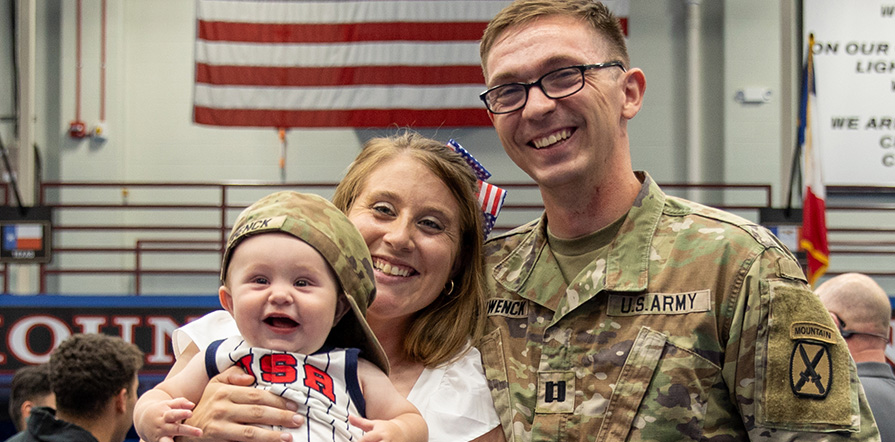
Enhancing the Well-Being of Our Service Members and Families



 Support for Military

Quick guidance & answers


We recognize the service and sacrifice of our military and their families, and dedicate resources, services, policies and programs to support the more than 2 million uniformed service members and 2.4 million family members across the globe.
Following is information on initiatives to address issues critical to force and family stability, including securing affordable basic needs, making moves easier, strengthening support to families and expanding spousal employment.
For more information, visit Taking Care of Our People.
Our military families must be secure in their ability to afford the basics. Below is a summary of initiatives, which include:
Learn more about the economic security initiatives:
WHAT IS IT? An HCFSA is an optional benefit that enables service members to use pretax earnings to pay for eligible health care expenses. Each service member can contribute between $100 to $3,300 per year to their account. Households where both earners are eligible for an HCFSA through their employer can maintain two separate accounts and contribute between $200 to $6,600 total per year. Service members must use and claim the funds in their account by the end of the plan year, Dec. 31, and may carry over up to $660 of unused funds to the next year if they reenroll.
WHO IS ELIGIBLE? Service members in the active component and certain reserve component members performing Active Guard Reserve duty are eligible. HCFSAs are already available to DOD civilian employees.
HOW TO ACCESS: Service members can enroll online during the open enrollment period at fsafeds.gov. The department will conduct a robust benefit campaign to ensure service members understand the benefit and enrollment process.
Download the Health Care Flexible Spending Accounts Fact Sheet
WHAT IS IT? The military departments will conduct a review of the standard-issue uniform clothing provided to the enlisted force to determine if the items meet their intended wear life. A separate, but parallel review, led by the undersecretary of defense for Personnel and Readiness in coordination with the military departments, will assess whether the annual cash clothing replacement allowance paid to enlisted members is sufficient to offset the cost of replacing uniforms as they wear out over the course of their normal use.
WHO IS ELIGIBLE? While “eligibility” doesn’t directly apply to these reviews, ensuring that the uniform clothing issued to the enlisted force is well-made, reliable and performs as expected, and that the cash replacement allowance is sufficient for enlisted service members to replace uniform items without extraordinary out-of-pocket costs, are at the heart of the reviews. Moreover, the results of the reviews will ultimately impact the well-being and readiness of every enlisted member of the force, from the new E-1 entering basic training to the most seasoned senior E-9 at the pinnacle of their career.
HOW TO ACCESS: The quality review of the standard-issued uniform clothing will be performed by April 2025. The review of the enlisted cash uniform replacement allowance rates will be finished by September 2025.
Download the Easing Uniform Costs and Improving Uniform Quality for the Enlisted Force Fact Sheet
Q: Is there any kind of enrollment fee? Does the service member have to pay or will DOD or the services pay?
A: There are no enrollment fees for service members. The military departments pay all enrollment fees on behalf of the member, by law.
Q: Can you provide some examples of what kind of health care costs the HCFSA could be used for?
A: Eligible expenses include copayments and cost shares, deductibles, dental (braces and orthodontia), vision (glasses and contact lenses), prescription drugs and wellness treatments (acupuncture, massage and chiropractic care). Eligible products also include bandages and over-the-counter medicine. HCFSA can be used for over 300 IRS-approved health expenses.
Q: Is the $3,300 in pretax earnings contribution per service member or family?
A: Each service member can contribute between $100 to $3,300 per year to their account. Households where both earners are eligible for an HCFSA through their employer can maintain two separate accounts and contribute between $200 to $6,600 total per year. Contributions are subject to Internal Revenue Service limits, which vary by tax year.
Q: Do DOD civilians have access to health care flexible spending accounts?
A: HCFSAs are already available to DOD civilian employees. DOD civilians enroll during the 2024 Federal Benefits Open Season and cannot enroll during the special enrollment period offered to service members.
Q: Will reserve component service members be able to enroll?
A: Service members in the regular active component and reserve component members performing active Guard and reserve duty pursuant to 10 USC 12301(d) are eligible. Members performing active Guard and reserve duty pursuant to Title 32 are not eligible. The department is exploring avenues to expand reserve component eligibility for this benefit.
Q: What will the review of the standard-issued uniform clothing items focus on?
A: The focus of the quality review is the standard-issue uniform clothing provided to enlisted service members in their clothing bags at basic training. During the review, experts from the military departments and the Defense Logistics Agency will take an in-depth look at the quality standards and design criteria for the production of the uniform clothing.
Based on the findings of the review, these experts will make appropriate recommendations, if any, to modify the quality standards or design criteria for items in the military services’ clothing bags. The precise details and exact scope of the review will become known military departments, along with DLA, begin to meet.
Q: What is the current enlisted monetary uniform replacement allowance rate for enlisted service members? How often is the rate adjusted?
A: The 2025 annual enlisted replacement allowance rates by military service and sex are depicted in the table below. The monetary allowance is for the replacement of uniform clothing items classified as uniquely military.
The dollar value of the allowance is determined by the unit prices and established wear-life cycles of these items (i.e., the estimated wear life of each item based on normal wear and tear). The allowances are adjusted annually based upon changes in unit prices of these items and changes to their wear-life estimates.
The amount of the allowance paid annually to enlisted service members reflects the total value of the standard-issue uniform clothing prorated over the established wear-life of the items. Uniform clothing items are sold at cost in the military clothing stores operated by the exchanges.
Service members who replace these items at military clothing stores, in synchrony with the established wear-life cycle, will have received the necessary allowances to offset the costs of those items. The allowances differ by service because of the differences in uniform clothing requirements of each service.
For example, Marines are required to possess and maintain both a “class A” uniform and a service dress uniform; this requirement translates into a significantly higher replacement allowance that is paid to enlisted Marines than is paid to members of the other services.
| FY2025 Enlisted Cash Clothing Replacement Allowances | ||
|---|---|---|
| Service | Sex | Standard Annual Value |
| Army | male | |
| female | $573.45 | |
| Navy | male | $561.60 |
| female | $568.80 | |
| Air Force/Space Force | male | $567.48 |
| female | $582.96 | |
| Marine Corps | male | $858.96 |
| female | $869.04 | |
Service members and families are required to move frequently, and these moves often come with costs that strain budgets. Initiatives include:
Learn more about the moving initiatives:
WHAT IS IT? This initiative directs DOD to work with interagency partners to:
WHO IS ELIGIBLE? Service members on active duty and their families who are moving in conjunction with a PCS and who need to occupy temporary lodging at the new or old CONUS duty stations (for TLE), or the old OCONUS duty station (for TLA), are eligible.
The study evaluating household goods weight allowances will encompass allowances applicable to enlisted service members and officers.
HOW TO ACCESS: Changes to TLE and TLA policies will be made as soon as possible in coordination with the eight uniformed services. The study’s results will be available in 2025.
Q: What is Temporary Lodging Expense?
A: TLE is intended to partially reimburse a service member for the cost of lodging and meals when he or she or a dependent occupies temporary lodging in CONUS during a PCS move.
Q: What is the current TLE? What is the new TLE and when does it take effect?
A: Currently, a service member may be authorized TLE for 14 days if the new permanent duty station and the old PDS are in CONUS or seven days in CONUS if either the new or the old PDS location is OCONUS.
The new TLE allowance would authorize 21 days of TLE if the new PDS and old PDS are in CONUS. Implementation will be as soon as possible, but only after current TLE policies are updated in coordination with all the uniformed services, including those outside of DOD
(Coast Guard, Public Health Service and the Commissioned Corps of National Oceanic and Atmospheric Administration).
Q: What is Temporary Lodging Allowance?
A: TLA is intended to partially pay a service member for expenses incurred by a member or dependent while occupying temporary lodging at an OCONUS duty station. TLA is available when it is necessary for a service member or dependent to occupy temporary lodging upon
arrival at or immediately before leaving, PDS OCONUS or during other periods as specified in the DOD FMR, Volume 7A, Chapter 68.
Q: What is the current TLA? What is the new TLA and when does it take effect?
A: Currently, upon arrival at an OCONUS PDS in conjunction with a PCS, a service member or dependent who occupies temporary lodging is authorized up to 60 days of TLA, as a standard, but can request additional days as necessary.
When departing an OCONUS duty station during a PCS, TLA typically cannot start more than 10 days before a service member or dependent leaves an OCONUS PDS; in certain situations, TLA can start earlier. The new TLA initiative will increase the TLA start date when leaving
an OCONUS PDS from 10 days prior to departure, as a standard, to up to 60 days prior as necessary, matching the arrival TLA period.
Implementation of this initiative will occur as soon as possible, but only after the applicable TLA policies are updated in coordination with the eight uniformed services.
Q: What are the current household goods weight limits for enlisted and officers?
A: The following table provides the current maximum household goods weight allowances for the various pay grades for members with and without dependents.
| Rank | With Dependents | Without Dependents |
|---|---|---|
| O-10 to O-6 | 18,000 | 18,000 |
| O-5 to W-5 | 17,500 | 16,000 |
| O-4 to W-4 | 17,000 | 14,000 |
| O-3 to W-3 | 14,500 | 13,000 |
| O-2 to W-2 | 13,500 | 12,500 |
| O-1, W-1, or Service Academy Graduate | 12,000 | 10,000 |
| E-9 | 15,000 | 13,000 |
| E-8 | 14,000 | 12,000 |
| E-7 | 13,000 | 11,000 |
| E-6 | 11,000 | 8,000 |
| E-5 | 9,000 | 7,000 |
| E-4 | 8,000 | 7,000 |
| E-3 to E-1 | 8,000 | 5,000 |
| Aviation Cadet | 8,000 | 7,000 |
| Service Academy Cadet or Midshipman | N/A | 350 |
Q: Do you have a timeline for when the study on increasing household goods weight tables for the force will be finished? What is next after that?
A: The study will be completed by the end of 2025, and the uniformed services will consider implementation of any recommendations that might come from the study.
Q: How many service members make PCS moves each year?
A: In Fiscal Year 2023 (the most recent full year’s data available), service members made over 425,000 PCS moves.
Military spouses provide a strong foundation that supports our service members and their families. Initiatives focused on:
Learn more about the new military spouse career initiative:
WHAT IS IT? MyCAA is a career development initiative that provides a maximum tuition benefit (scholarship) of $4,000, with an annual fiscal year cap of $2,000, to assist eligible military spouses who need professional credentials to meet their career goals. Participating military spouses may use MyCAA funding for the pursuit or maintenance (including testing for credit and continuing education units) of a license, certification or associate degree necessary to gain employment in an occupation or career field. Through a 2018 RAND study, MyCAA was shown to impact spouses’ ability to find employment with higher rates of compensation.
WHO IS NOW ELIGIBLE? With this expansion, military spouses of active-duty service members and spouses of National Guard and reserve members on Title 10 orders in grades E-1 through E-9, W-1 through W-3 and O-1 through O-3 can register for MyCAA financial assistance.
HOW TO ACCESS? To get started, spouses can verify eligibility and register for a MyCAA account. After registration, spouses will then work with a Spouse Education and Career Opportunities career advisor or career coach on a MyCAA Education and Training Plan. This plan will be reviewed as part of the application process for the MyCAA scholarship, and when approved, the spouse can then receive financial assistance.
Download the Expanded Eligibility for MyCAA Financial Assistance Fact Sheet
Q: How does this expansion support military spouses in finding meaningful employment?
A: MyCAA is a workforce development program designed to provide military spouses with financial assistance in furthering their education and training related to entering or advancing within the workforce. By expanding the program, more spouses who may not have been able to commit to training and education in the past are now eligible for financial assistance.
Q: What other resources is the department deploying to impact the challenges military spouses face in finding meaningful employment?
A: The department’s Spouse Education and Career Opportunities program, which includes MyCAA, provides numerous resources and opportunities for military spouses.
This support includes the SECO Career Center where spouses can leverage master’s level career coaches for free; the Military Spouse Career Accelerator Pilot, which is a competitive, 12-week, paid fellowship; and the Military Spouse Employment Partnership, which connects spouses to employers committed to hiring military spouses.
We highly recommend that all military spouses visit MySECO.MilitaryOneSource.mil or contact Military OneSource and ask to be connected to the SECO Career Center to learn about all of the programs available to them through SECO.
Reliable housing and well-maintained facilities are essential for the health, safety and overall well-being of service members and their families. Initiatives focused on:
Following are initiatives to expand support for families and make it easier to find affordable, quality child care options:
Learn more about the family support initiative:
WHAT IS IT? This investment will allow the department to redesign the child care provider compensation model to offer mid- to senior-level staff and management more competitive wages and modernize the child care workforce.
WHO IS ELIGIBLE? Child development program classroom staff and managers will be eligible for increased compensation.
HOW TO ACCESS: To apply for Child and Youth Program positions, search “child and youth” at www.USAJOBS.gov to find career positions where you live. To request child care, visit MilitaryChildCare.com.
Download the Increasing Access to Quality Child Care Fact Sheet
Q: How will the increase in child care provider compensation affect child care fees for military families?
A: Child care fees for military families will remain the same for the 2024-2025 school year. The Defense Department remains committed to its mission to offer a range of quality, affordable child care options to meet the needs of military families.
Access to affordable child care is a readiness issue; therefore, the president’s fiscal year 2025 budget request includes a $33.5 million investment in improvements to child care staff compensation and workforce modernization.
Q: Will military families see increases in their child care fees to make up for improved child care provider compensation?
A: No, increased compensation for child care staff will not be passed on to parents. The president’s FY 2025 budget request includes a $33.5 million investment to improve child care compensation and modernize the workforce. The Defense Department remains committed to
its mission to offer a range of quality, affordable child care options to meet the needs of military families.
Q: Modernization of the child care workforce adds two key positions — lead educator and special needs inclusion coordinators. How do these positions enhance the support of children served by military child development centers?
A: The lead educator will provide hands-on coaching and close supervision to child care staff. Special needs inclusion coordinators will coordinate intervention and inclusion services and provide direct classroom support. These positions are key to increasing upward
mobility for child care staff, adding professional positions to support military spouses and solving classroom climate challenges by adding more supervision, assistance and expertise.
Q: Why were changes to the child care compensation model needed?
A: The Defense Department conducted a thorough review of its 30-year-old child care staffing and compensation model and put forward a strategy to increase compensation for mid-to-senior level classroom staff and program management.
The revised compensation model is based upon a review of current duties and responsibilities, current performance expectations and increased training requirements for child and youth professionals. The redesigned child care compensation model seeks to retain skilled
staff, attract diverse applicants and create pathways for career growth.
Q: How will these initiatives increase access to quality child care?
A: Improvements in recruitment, retention and working environments will help make DOD the employer of choice for the child care workforce. Filling staffing vacancies will provide the workforce needed for department child development program facilities to offer care to
as many military families as possible.
Q: Who will be eligible for increased compensation?
A: Mid-to-senior level classroom staff and program management will be eligible for increased compensation.
Q: When will staff receive their increased compensation?
A: The department included $33.5 million in the president’s budget for FY 2025 to fund this initiative. The DOD is targeting a phased approach with an April 1, 2025 implementation date, pending receipt of appropriations.
Initiatives to ensure service members have access to critical resources, stay connected with loved ones and maintain healthy, supportive environments include:
Learn more about the quality of life initiatives:
WHAT IS IT? The Defense Department will review three remote and isolated installations via its On-Site Installation Evaluation, or OSIE, process and methodology. On Feb. 26, 2021, OSIE focuses on an
installation’s prevention capabilities and ability to effectively address risk for a myriad of harmful behaviors so leaders can take corrective actions and enhance prevention capabilities. OSIE also provides the department an understanding of the “ground truths” of both data-informed issues/concerns and data-informed positive indicators at these locations.
WHO IS ELIGIBLE? Three remote and isolated installations will be selected using installation-based quality of life indicators and the department’s multipronged resilience index, which assesses risk and protective factors at the individual, leadership, workplace, installation and community levels. Two remote/isolated sites that are low in resilience and quality of life and one site high in resilience and quality of life will be prioritized for site visits.
HOW TO ACCESS: A report containing findings, best practices, lessons learned and solutions will be prepared and submitted to
leadership.
Download the Making Life Easier at Remote and Isolated Installations Fact Sheet
WHAT IS IT? This initiative directs the military departments to carry out a series of pilot projects to provide Wi-Fi to enlisted service members residing in unaccompanied housing, or UH, free to the service member.
WHO IS ELIGIBLE? Junior enlisted service members living in UH at pilot-selected locations are eligible.
HOW TO ACCESS: The Defense Department is establishing a long-term plan to build a Wi-Fi-connected force. The undersecretary of defense for acquisition and sustainment will work with the military departments to track the pilot programs, share best practices and engage with internet service providers to develop innovative programs for the provision of Wi-Fi to members in UH.
Q: What are On-Site Installation Evaluations?
A: On-Site Installation Evaluations, or OSIEs, focus on an installation’s prevention capabilities and ability to effectively address risks for a myriad of harmful behaviors so leaders can take corrective actions and enhance
prevention capabilities.
They also provide the department an understanding of the “ground truths” of both data-informed issues/concerns and data-informed positive indicators for the quality of life that exist across the total force.
At each site, OSIE teams work collaboratively with leadership at the local and service levels to assess the installation’s capabilities to prevent harmful behaviors that include suicide, harassment, sexual assault, substance abuse, domestic abuse and child abuse and neglect.
Specifically, teams use validated, standardized metrics to look at the site’s capability to create healthy climates, support well-being, implement integrated prevention and incorporate service member, DOD civilian employee, family member and other stakeholder voices and needs in prevention efforts.
Due to the success of the 2021 OSIE cycle, the Defense Department directed this effort to continue biennially. As a result, the department completed 2023 OSIE visits, and the next round of visits will occur in 2025. View reports from previous OSIE visits.
Q: Which three “remote and isolated installations” will be visited during the 2025 OSIE process? Will any be OCONUS?
A: Of the three remote and isolated installations to be selected, two will be chosen from sites determined as low in resilience and quality of
life, with one determined as high in resilience and quality of life.
Three remote and isolated installations will be selected using installation-based quality of life indicators and the department’s multipronged Resilience Index, which assesses risk and protective factors at the individual, leadership, workplace, installation and community levels.
Since 2021, OSIE teams have visited a variety of small, geographically isolated, reserve component and OCONUS locations to ensure a comprehensive understanding of prevention capabilities and needs. Examples include an Army Recruiting Company in Dearborn, MI; Joint Base Elmendorf-Richardson; an Army Reserve unit in Ashley, PA; and Naval Station Rota.
Q: When will the 2025 OSIE process start, and when will the report be finished?
A: A report providing an overview of the methodology used for site selection and on-site evaluation, a summary of findings, gaps, best practices,
lessons learned and recommendations will be published following the completion of site visits.
Q: What kind of Wi-Fi pilot projects already exist? Can you provide a few examples?
A: The department has a few existing Wi-Fi pilot programs.
The Department of the Navy launched an MWR “Virtual Single Sailor Program” pilot in November 2023 to provide a minimum level of high-speed internet access (e.g., 30-60 MB download speed) to service members for free, in selected unaccompanied housing, or UH, in the general vicinity of Naval Station Norfolk.
The Department of the Air Force has undertaken a distinct pilot to provide free internet/Wi-Fi access for service members residing in UH while at Air Education and Training Command schools to facilitate Department of the Air Force technical school training.
We are excited to build off of these existing programs to provide access to more service members.
Q: Why is the initial focus limited to unaccompanied housing? What about families who live in on-base housing or service members who live off base?
A: The department is exploring different ways to provide Wi-Fi to service members. The initial focus is on UH for a few reasons. First, our junior enlisted service members are most likely to have been assigned to live in UH and have limited choice for internet access. Second, we are utilizing the department’s various existing authorities to provide internet access to enlisted service members living in UH. Unlike UH, which is government-owned and controlled, much of our on-base family housing is privatized, and people living off base are living in privately owned or rented homes as well. The department is working to determine what, if any, additional authorities may be needed and can be used to help provide Wi-Fi in these cases where we lack jurisdiction.
Q: What’s the timeline for a long-term plan to increase access to Wi-Fi?
A: The department is currently establishing a long-term plan to increase Wi-Fi access and will build off of the lessons learned in the FY24 and FY25 pilots.

Military OneSource from the Defense Department is your 24/7 gateway to trusted information, resources and confidential help. When MilLife happens, it's your “first line of support” — giving service members and military families tools to stay well and thrive. Call us anytime at 800-342-9647 — we're here for you. Learn more »

Learn about military bases worldwide. Get installation overviews, check-in procedures, housing, contacts for programs and services, photos and more.

Alert
We’ve transitioned to a new contact center. Wait times may be longer than usual as we work to improve your experience. Connecting you to support remains our top priority. We appreciate your patience.
For emergencies, please call 911.