Close
My Military
OneSource App
ARTICLE

Meeting Military Fitness Standards

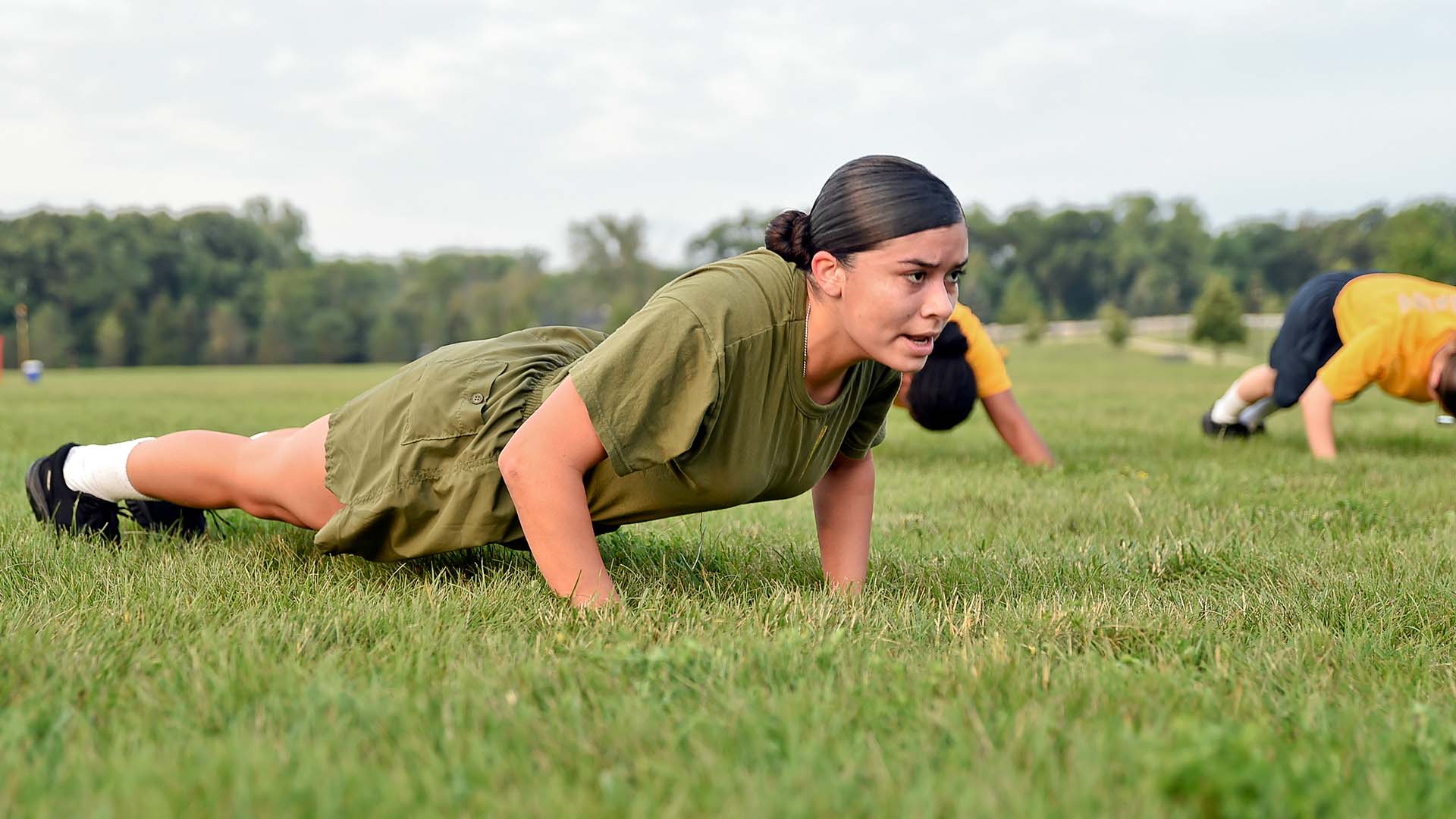
Service member doing pushups

Physical fitness is a big part of life in the military. It’s required. To make sure our military force is mission ready, each service member — regardless of age, grade or duty assignment — is regularly tested. While there are some exceptions to the rule, you’ll have to prove your physical fitness regularly.

What to expect

Each service branch requires its own unique fitness test, but generally, they include:

  • Pushups, between one and two minutes, timed
  • Situps, between one and two minutes, timed
  • A one-and-a-half, two- or three-mile timed run
  • Other fitness requirements, such as pullups, flexed-arm hang and lifts

The Army Fitness Test has five events that assess your ability to perform physical tasks you may encounter in combat conditions:

  1. Strength deadlift: You must perform a three-repetition deadlift with the weight increased with each repetition. The weight range of the deadlift is 120 to 420 pounds. The deadlifts replicate picking up ammunition boxes, a wounded soldier, supplies or heavy equipment.
  2. Hand-release pushups: You will have two minutes to do as many hand-release pushups as possible. Depending on your job, there may be a minimum number you are required to complete. These are similar to traditional pushups, but at the down position, you lift your hands and arms from the ground and then reset to do another pushup.
  3. Sprint/drag/carry: You must run five times up and down a 25-meter lane, sprinting, dragging a sled weighing 90 pounds and then carrying two 40-pound kettlebell weights. This can simulate pulling a soldier out of harm’s way, moving quickly to take cover or carrying ammunition to a fighting position or vehicle.
  4. Plank: You must maintain a proper plank position for as long as possible.
  5. Two-mile run: This is a timed run to build endurance and cardiovascular strength.

You must complete all of these events in a single session.

The AFT is scored on a point system, with each of the six events worth up to 100 points, for a maximum total score of 600 points. Soldiers must earn at least 60 points per event to pass, though specific job-related standards may require higher performance levels.

The Marine Corps places a strong emphasis on physical fitness as a core element of combat readiness. Marines are expected to maintain peak physical condition, and their fitness assessments reflect the demanding nature of their role in expeditionary and ground combat operations.

Marines must complete two annual fitness evaluations:

  1. Physical Fitness Test – measures general physical readiness.
    • Pullups (or pushups): Maximum reps in two minutes. Pullups earn more points.
    • Plank: Held for time, replacing the traditional abdominal crunch.
    • Three-mile run: Timed cardiovascular test.
  2. Combat Fitness Test – evaluates functional combat movement.
    • Movement to contact: Timed 880-yard sprint in boots and utility uniform.
    • Ammunition can lifts: Repeated lifts of a 30-pound ammo can overhead for two minutes.
    • Maneuver under fire: Course simulating battlefield movement, including buddy drag, agility runs and grenade toss.

The PFT and CFT are each scored out of 300 points, with three events worth up to 100 points each. Performance standards for both tests vary by age and sex, and Marines must meet the minimum score in each event to pass. Together, these tests evaluate a Marine’s overall physical fitness and combat readiness.

The Navy Physical Readiness Test measures muscular endurance and aerobic capacity. It also includes a body composition assessment measuring height/weight, abdominal circumference and body fat. The Navy conducts PRT twice a year for all active-duty and reserve sailors, and recruits at boot camp are also evaluated.

The PRT has three events: pushups, forearm plank and a 1.5-mile timed run. The alternate cardio options to the 1.5-mile outdoor run/walk include the following: a timed 500-yard swim, 12-minute stationary cycle or 1.5-mile run/walk on a treadmill. Your commanding officer can choose to permit alternate cardio.

  • 1.5-mile run: Run 1.5 miles as quickly as possible.
  • 500-yard swim (alternate cardio): Swim as quickly as possible.
  • Stationary cycle (alternate cardio): Burn the maximum calories possible in 12 minutes.
  • 1.5-mile treadmill: Run/walk for best time.
  • Pushups: Do as many pushups as you can in two minutes.
  • Forearm plank: Hold the proper position for the forearm plank for as long as you can or until time is up.

PRT scoring has five categories – (1) Outstanding (levels: high, medium, low); (2) Excellent (levels: high, medium, low); (3) Good (levels: high, medium, low); (4) Satisfactory: (levels: high, medium) and (5) Probationary. To pass the PRT, you must achieve a score of probationary or higher in all three events.

Check to see the latest updates from the Navy on how the exercises are used and scored in the PRT.

The Air Force gives service members flexibility in how they demonstrate fitness. The focus is on functional health and long-term wellness, aligning with the Air Force’s mission and operational requirements. The current test includes pushups, situps and a 1.5-mile run.

Airmen are tested twice a year, unless exempt for medical or deployment reasons. They must meet a minimum composite score of 75 out of 100 and minimum standards in all components.

The Space Force is developing a next-generation approach to health and fitness that goes beyond traditional testing. The service emphasizes holistic wellness, including sleep, mental health, strength, mobility and cardiovascular fitness. For now, Guardians participate in the Air Force’s fitness assessment.

The new wellness framework being tested includes:

  • Wearable fitness trackers to monitor activity levels and recovery
  • Periodic health check-ins rather than a one-time physical test
  • Metrics for sleep quality, mental resilience, strength and flexibility

The long-term goal is to reduce injury, encourage year-round fitness and reflect the unique, less physically combat-intensive missions of the Space Force.

The Coast Guard’s fitness requirements support its maritime law enforcement, search-and-rescue and disaster response missions. Physical readiness is essential for operating in dynamic and often hazardous environments at sea and onshore.

All recruits must pass a physical fitness test before entering boot camp. Active-duty members are also subject to periodic testing. The standard test events include:

  • Pushups: Maximum reps in one minute.
  • Situps: Maximum reps in one minute.
  • 1.5-mile run: Timed cardiovascular test.
  • Sit-and-reach: Measures flexibility.

A new initiative called the Body Composition Pilot Program is being evaluated to more accurately assess body fat and overall fitness. Although swimming is not a formal part of the regular fitness test, strong swimming ability remains essential for operational readiness.

The PFT is scored on a pass/fail basis. To pass, members must meet minimum standards in each of the required events. The standards vary by age and sex, and all four components must be passed during a single test session. Unlike other branches, the Coast Guard emphasizes readiness for maritime missions over competitive scoring.

How to prepare yourself in advance

Be ready to perform. Here’s how to prepare:

Improve your endurance. Take advantage of your installation’s MWR programs, fitness centers and swimming pools.

Have a fitness plan. Put your training plan in place at least six weeks before the test. Track your progress in writing. Note where you need to improve. Have a backup plan for temporary interruptions.

Train with a buddy. The support and encouragement are priceless.

Pretest yourself. Do it weekly. Time yourself on each of the events in the test. Work hard on improving your score.

Cut down on fast food. Or you’ll wish you did. Stay hydrated. Get good sleep.

The Navy offers several free tools to help you prepare for the PRT, as well as maintain your health and fitness.

  • Official Navy PFA focuses on health and fitness, including good nutrition, meal plans and training videos for bettering your form and time on the PRT.
  • The Navy Operational Fitness and Fueling System is a series of apps that provides best-in-class physical fitness and nutrition information for sailors with different fitness objectives and in different training situations. NOFFS includes:
    • Strength Series to develop the strength needed to perform at the highest levels.
    • Endurance Series to develop cardiovascular fitness while improving muscular strength.
    • Sandbag Series for training in environments with limited equipment options.
    • Operational Series with training plans for different Navy platforms: submarines, large-deck and small-deck ships, and group training.

Tips for test day

Doing the right things before the test will make a big difference. Follow these tips:

Don’t test on sore muscles. Relax up to two days before the test or up to five days if you’re older than 40.

Drink and eat right the night before. Drink plenty of water. Eat fruits, vegetables and lean proteins.

Just one light meal on the day of your test. If you need immediate energy, eat an apple, banana or carrots.

Dress right. Wear a T-shirt, shorts and running shoes.

Get the hydration right. Drink two to three cups of water two to three hours before the test. Then:

  • Drink one cup of water just before the test.
  • Drink small amounts of water slowly during breaks.
  • After the test, drink two to three cups of water in the first two hours.

Warm up. Do a lighter version of each exercise, such as jogging before running.

Cool down. After the test, cooldown exercises help your heart and breathing return to their resting rates.

Need help or inspiration to get ready for your next fitness test? Contact Military OneSource’s health and wellness coaching online or call 800-342-9647, and a Military OneSource consultant will register you and schedule your first session with a health and wellness coach.

Learn about military bases worldwide. Get installation overviews, check-in procedures, housing, contacts for programs and services, photos and more.

Find an Installation