Close
My Military
OneSource App
ARTICLE

How to Successfully Communicate as a Couple

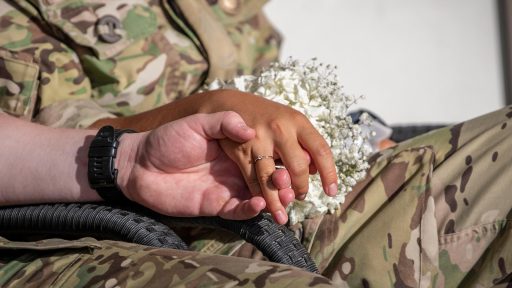
service member and spouse reunite

For service members, a loving marriage is both a source of personal happiness and an important part of family readiness. When your relationship is strong and healthy, you can focus on your mission and daily duty requirements. Like any relationship, marriages take work and attention.

Communicating well is one of the most important skills any couple can have, and a key component of lasting, loving relationships. Working with your partner to learn and practice basic communication techniques can help you build trust and intimacy in your relationship.

Every couple will need to talk about a difficult or painful subject at some point. You may be tempted to avoid discussing hot-button topics for fear you’ll get into an argument, but working through challenges with an open mind can bring you closer together.

These tips can help:

  • Check your feelings. Try not to go into a conversation assuming your partner will react a certain way. Rid yourself of negative feelings as much as possible so you can approach the topic with an open mind.
  • See if it’s a good time to talk. Avoid starting serious conversations when children might overhear, or when either of you is busy or tired. If it can’t wait, but your partner is busy, let them know that you understand it’s not the best time to talk but that the matter needs attention.
  • Speak slowly and clearly. Do not raise your voice or mumble.
  • Match your tone to your message. The way you say something can be as important as what you say. Your partner may be confused if you disguise your feelings by sounding upbeat when you are upset, or if you bring up a minor issue in a dramatic way.
  • Share your thoughts and feelings. Make an extra effort to share the things that matter to you most.
  • Be honest. Don’t expect your partner to read between the lines. Say what you mean.
  • Be an active listener. Give each other your full attention, free of interruptions. Turn off the television, and let phone calls go to voicemail. Hear what your partner is saying rather than planning your response or letting your mind wander.
  • Show that you’re listening. Nod or ask questions. Try repeating back what you heard through phrases such as, “So what you’re saying is …” or, “If I understand you correctly, you feel …”
  • Offer frequent praise, support and encouragement. Studies show that couples who stay together make far more positive comments to each other than negative ones.
  • Stay connected. The Love Every Day texting program prompts you and your partner to connect in new ways, build intimacy and rekindle the spark. Log in to your Military OneSource account to get started.
  • Watch your body language. Uncross your arms, relax your face and shoulders and make eye contact with your partner. You can even lean in a bit when you talk. This signals that you are receptive to what your partner has to say.

Good communication takes practice. The key is making a commitment to keep working at it together.

Some conversations are harder than others, but you can handle them more effectively with a thoughtful approach:

  • Keep your sense of humor. Using humor can break tension and help you connect during times of stress and pressure.
  • Bring up one difficult subject at a time. Raising a lot of sensitive issues in the same conversation can leave the other person feeling confused and defensive.
  • Make “I” statements. Be specific about how you feel. Express your feelings with neutral comments such as “I feel …” “I’m concerned that …” or “I’m worried that …” instead of phrases that put people on the defensive, such as “You never …” “You always …” or “You’re so …”
  • Talk about the issue, not who’s right or wrong. Focus on finding a solution instead of assigning blame.
  • Acknowledge the other person’s point of view. Make an effort to show you’re listening and understand, even if you don’t agree.
  • Take a break if needed. Take 15 minutes to be alone and calm down if your conversation becomes heated or you’re on the verge of saying things you’ll regret. Taking time out can help defuse a situation, but it will not resolve the situation. Commit to revisiting the issue when your emotions are under control.
  • When possible, have important conversations in person.

Here are some more steps you can take if your partner has a hard time opening up or seems to tune you out.

  • Avoid making assumptions. You may think your partner doesn’t want to talk because they are angry with you. However, there may be something else — perhaps an incident at work — that’s upsetting them.
  • Consider your spouse’s family background. Some people grow up in families where difficult conversations lead to conflict.
  • Remember that it can be hard to open up. Your partner may be worried about feeling rejected if he or she expresses their views honestly.

Need to talk? Free and confidential counseling is available for individuals and couples.


Counseling is available for service members and their partners. Get started by using the Military and Family Life Counselor Locator, by contacting your installation’s Military and Family Support Center or by calling Military OneSource 24/7 at 800-342-9647. OCONUS/international? Use these calling options. You can also log in to start a secure live chat.

Help is available if you’re having ongoing difficulty communicating with your partner. Military OneSource offers free, education-focused Building Healthy Relationships Specialty Consultations.

Every relationship has its strengths and weaknesses; however, some are healthier than others. If you have concerns about yours, learn how to recognize unhealthy relationship behaviors and where to go for help.

We are sorry you didn't find this article helpful. Please provide a little more information to help us improve.

Learn about military bases worldwide. Get installation overviews, check-in procedures, housing, contacts for programs and services, photos and more.

Find an Installation